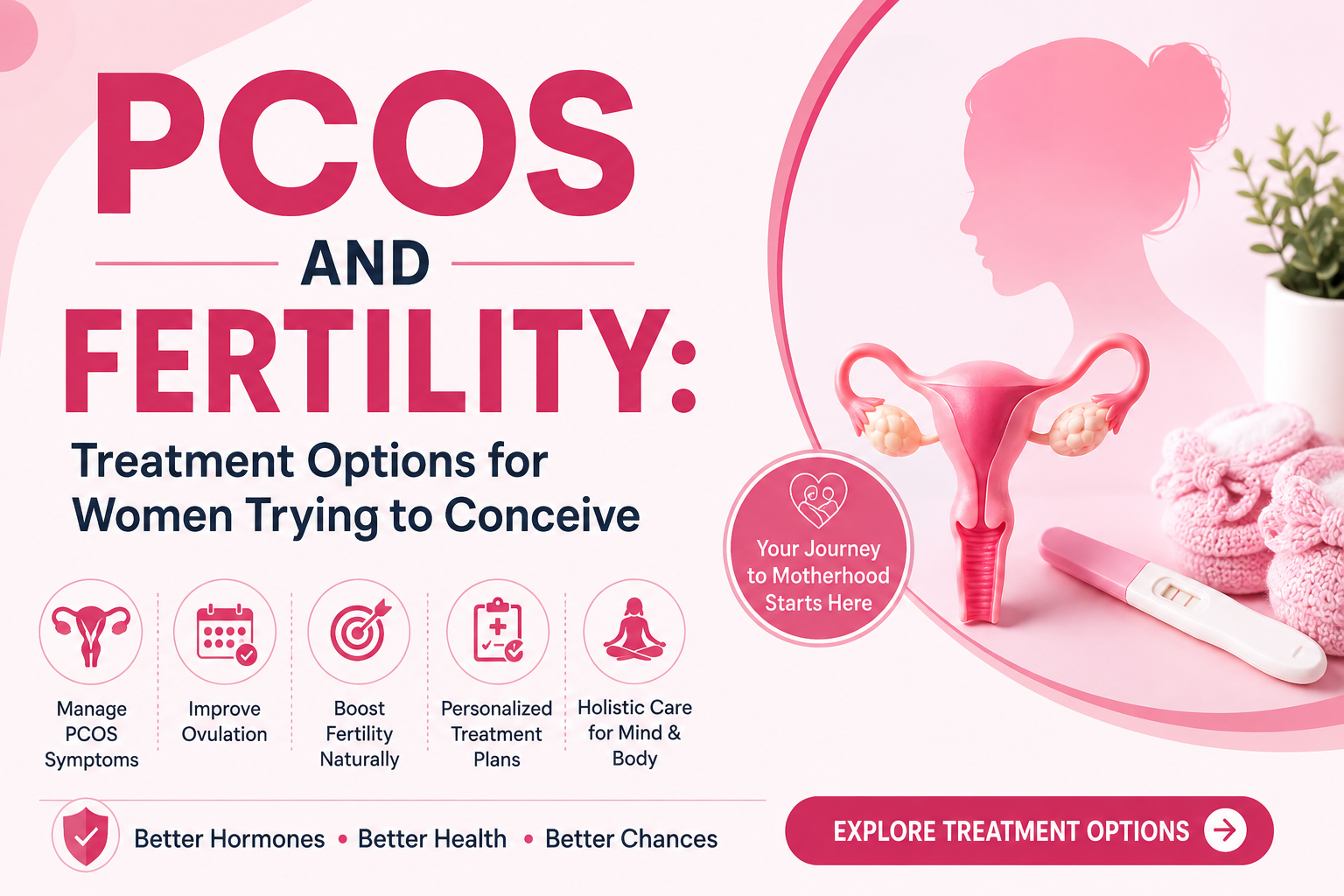
PCOS and Fertility: Treatment Options for Women Trying to Conceive
For many women, the journey to pregnancy does not begin with a positive test. It begins with questions: Why are my periods irregular? Am I ovulating? Will PCOS affect my chances of becoming pregnant?
If you have been diagnosed with Polycystic Ovary Syndrome (PCOS) and are trying to conceive, it is understandable to feel concerned about fertility. The good news is that PCOS does not mean you cannot become pregnant. Many women with PCOS conceive naturally or with appropriate fertility treatment. The right approach depends on ovulation, age, overall health and whether other fertility factors are present.
How Does PCOS Affect Fertility?
PCOS can affect fertility mainly because it may interfere with regular ovulation. When ovulation does not occur consistently, identifying the fertile window becomes difficult and conception may take longer.
You may notice:
- Irregular or missed periods
- Difficulty predicting ovulation
- Longer menstrual cycles
- Signs of hormonal imbalance
- Difficulty conceiving despite regular attempts
However, having PCOS does not automatically mean infertility. With proper evaluation and management, many women can improve their chances of conception. Current international guidance specifically recommends reassuring women with PCOS that pregnancy can often be achieved naturally or with assistance.
PCOS and Fertility: What Should You Do First?
Imagine a woman who has been trying for several months. Her periods have never been predictable, and every negative pregnancy test makes her more anxious. Instead of immediately assuming that IVF is the answer, the first step should be understanding why conception is not happening.
A gynecologist may assess:
- Ovulation – Is ovulation happening regularly?
- Menstrual pattern – How frequent and predictable are the periods?
- Medical history – Are there other conditions affecting fertility?
- Weight and metabolic health – These can influence reproductive outcomes.
- Partner factors – A semen analysis may be appropriate.
- Fallopian tube health – Tubal assessment may be considered depending on the individual situation.
This individualized evaluation is important because PCOS may be only one part of the fertility picture.
PCOS Fertility Treatment Options
Treatment is not the same for every woman. If PCOS is affecting ovulation, your doctor may discuss different approaches depending on your fertility assessment.
1. Lifestyle and Preconception Care
Healthy lifestyle habits are an important part of PCOS management and preparing for pregnancy. Depending on your individual health, your doctor may recommend improving nutrition, physical activity, sleep and management of conditions such as high blood pressure or diabetes.
Importantly, fertility care should not focus only on weight. PCOS is a complex hormonal and metabolic condition, and care should be individualized without weight stigma.
2. Ovulation Induction
When irregular or absent ovulation is the main reason for infertility, medication may be used to help stimulate ovulation.
According to the 2023 international evidence-based PCOS guideline, letrozole is recommended as the first-line pharmacological treatment for ovulation induction in women with PCOS who have anovulatory infertility and no other infertility factors.
Other medicines, including clomiphene citrate and metformin, may have a role in selected situations. Their use should be decided by a qualified doctor after evaluating the woman's individual circumstances.
3. IUI and Other Fertility Options
If ovulation treatment does not result in pregnancy, or if additional fertility factors are identified, treatments such as intrauterine insemination (IUI) may be considered.
The appropriate treatment depends on factors such as:
- Age
- Duration of trying to conceive
- Ovulation response
- Sperm health
- Fallopian tube status
- Previous fertility treatment
- Other reproductive conditions
4. IVF for PCOS-Related Infertility
IVF may be considered when other fertility treatments have not worked or when there is another indication for IVF. It is not automatically the first treatment simply because a woman has PCOS.
The current PCOS guideline places IVF later in the treatment pathway for anovulatory infertility when other ovulation-induction approaches have failed, unless there is an independent reason to proceed with IVF.
When Should You See a Gynecologist?
If you have PCOS and are trying to conceive, you do not need to wait until the situation becomes stressful or overwhelming.
Consider discussing your fertility with a gynecologist if:
- Your periods are very irregular or absent.
- You are unsure whether you are ovulating.
- You have been trying to conceive without success.
- You have previously experienced pregnancy loss.
- You have concerns about your fertility because of your age or medical history.
- You have already tried fertility treatment without success.
Dr. Madhumita Patel is a gynecologist, obstetrician and laparoscopic surgeon with over 20 years of experience in obstetrics and gynecology, and her practice includes infertility treatment and family planning. She provides gynecological care in Chattarpur and Vasant Kunj.
Can You Get Pregnant Naturally With PCOS?
Yes. PCOS does not mean pregnancy is impossible. Some women with PCOS conceive naturally, while others may need assistance to restore or support ovulation.
The important point is not to compare your fertility journey with someone else's. One woman may conceive after improving ovulation and overall health, while another may require medication or assisted reproductive treatment.
A proper fertility evaluation can help determine what is actually preventing conception and which treatment is appropriate.
Conclusion: PCOS and Fertility Can Be Managed
Being diagnosed with PCOS can make trying to conceive feel uncertain, but it does not mean you have to give up on your plans for pregnancy. PCOS and fertility problems are often manageable with timely evaluation and personalized treatment.
If irregular periods, unpredictable ovulation or difficulty conceiving are causing concern, speaking with an experienced gynecologist can help you understand your options rather than relying on assumptions or online advice.
If you are trying to conceive with PCOS, consult Dr. Madhumita Patel for an individualized fertility evaluation and discuss the treatment approach that may be appropriate for you.
Frequently Asked Questions
1. Can PCOS cause infertility?
PCOS can make conception more difficult, mainly when it causes irregular or absent ovulation. However, PCOS does not mean that a woman cannot become pregnant. Many women conceive naturally or with fertility assistance.
2. What is the best fertility treatment for PCOS?
There is no single treatment that is best for every woman. For women with PCOS who have anovulatory infertility and no other infertility factors, current international guidelines recommend letrozole as the first-line pharmacological ovulation-induction treatment.
3. Can I get pregnant naturally with PCOS?
Yes. Some women with PCOS become pregnant naturally. If ovulation is irregular or pregnancy is taking longer than expected, a gynecologist can evaluate the underlying fertility factors and recommend appropriate treatment.
4. Does PCOS mean I need IVF?
No. IVF is not automatically required for women with PCOS. Depending on the cause of infertility, ovulation induction and other fertility treatments may be considered before IVF.
5. When should I consult a doctor for PCOS and fertility?
If you have irregular or absent periods, difficulty identifying ovulation, or concerns about conception, it is reasonable to discuss your fertility with a gynecologist. Earlier evaluation can help identify whether PCOS or another factor is affecting your chances of pregnancy.
Take the Next Step Toward Managing PCOS and Your Fertility
PCOS does not have to mean uncertainty about your future pregnancy plans. The right evaluation and treatment approach can provide clarity on what may be affecting conception and help you move forward with confidence.
If you have been trying to conceive and want professional guidance, consult Dr. Madhumita Patel for a personalised fertility evaluation and gynecological consultation. Understanding your reproductive health is the first step toward making informed decisions about your fertility journey.
If you are looking for the best gynecologist in Delhi? Contact Dr. Madhumita Patel today!!!
Call Now: +91 9870267117, +91 8287939446
Clinic Address: Dr. Madhumita's Women Healthcare, 2441, D-2, Near Exit Gate 2, Vasant Kunj