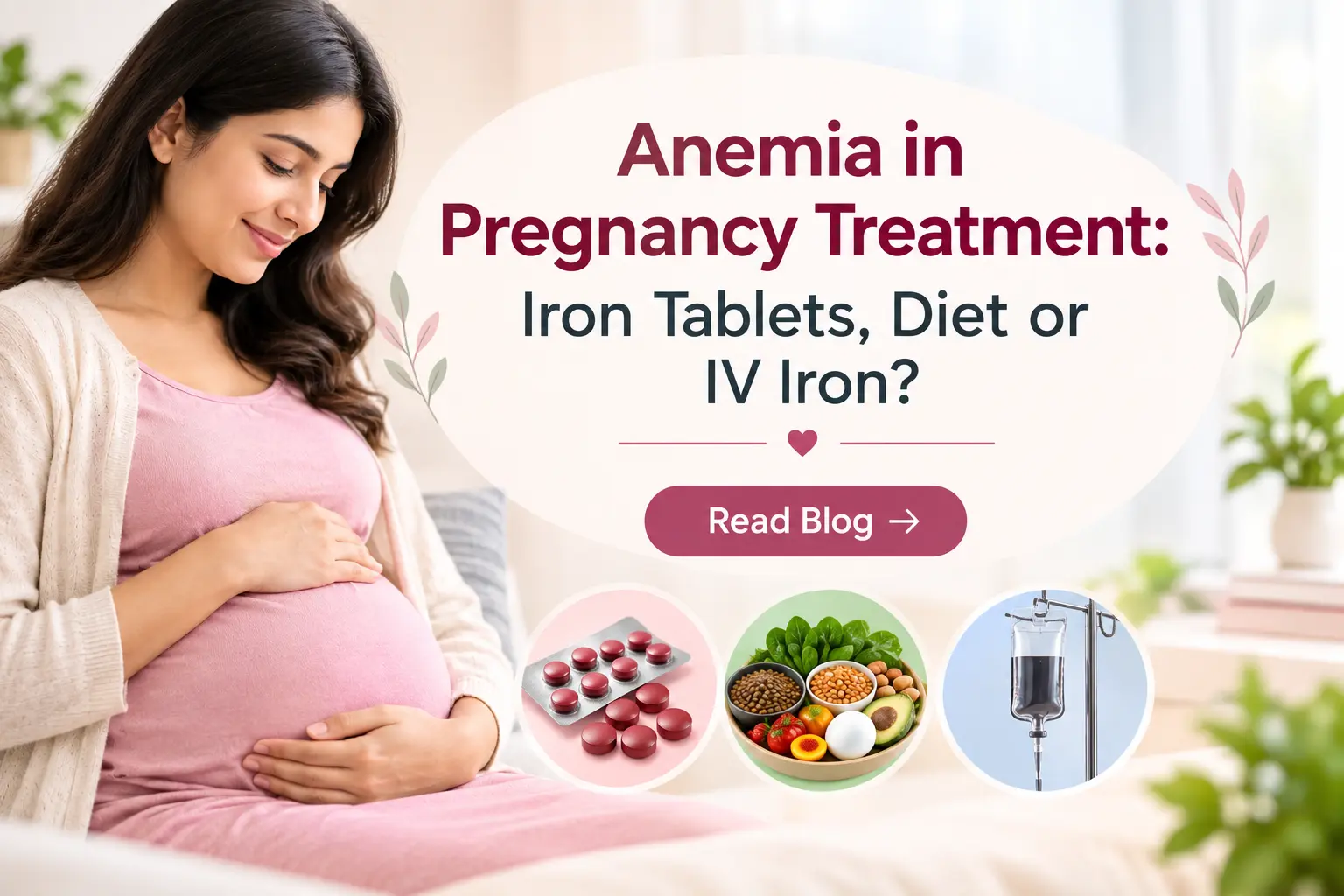
Anemia in Pregnancy Treatment: Iron Tablets, Diet or IV Iron?
A few weeks ago, a 27-year-old teacher from Vasant Kunj came to our clinic for her routine check-up at 24 weeks. She was healthy, happy and doing everything by the book. But she mentioned one small thing — climbing a single flight of stairs at school was leaving her breathless, and she had started falling asleep by 8 pm.
Her report came back with a hemoglobin of 8.2.
Her first question is the same question almost every expecting mother asks:
“Do I really need those iron tablets again? They upset my stomach. Can I just fix it with food?”
It is a fair question. And the honest answer is that anemia in pregnancy treatment is not one-size-fits-all. Sometimes tablets are enough. Sometimes food is only a support. And sometimes your baby cannot wait for a slow method to work. Let us break it down in simple language.
Why Anemia in Pregnancy Is So Common in India?
During pregnancy your blood volume increases by almost half. Your body is now building blood for two. If your iron stores were already low before you conceived, they run out fast.
Common reasons we see every day at the clinic:
- Low iron stores even before pregnancy, especially in women who had heavy periods
- A mostly vegetarian diet with very little iron from plant sources being absorbed
- Tea or coffee taken right after meals, which blocks iron absorption
- Two pregnancies close together, with no time for the body to recover
- Twins, morning sickness that stops proper eating, or a stomach infection
If your periods were unusually heavy before you conceived, that is often where the story starts. You can read more in our blog on heavy periods and their treatment options.
Signs You Should Never Brush Off
Tiredness in pregnancy is normal. This much tiredness is not:
- Getting breathless while doing simple daily work
- Dizziness, or a spinning feeling when you stand up
- Pale skin, pale inner eyelids, pale nails
- Fast heartbeat or fluttering in the chest while resting
- Headaches, poor concentration, cold hands and feet
- A strange urge to eat ice, mud or chalk
Low hemoglobin in pregnancy raises the risk of early labour, low birth weight and heavy bleeding after delivery. That is why we never treat it casually. Our guide on warning signs during pregnancy covers the other symptoms worth reporting immediately.
Option 1: Iron Tablets — The First Step in Anemia in Pregnancy Treatment
For mild to moderate iron deficiency anemia in pregnancy, oral iron is still the first choice. It is safe, cheap and works well when taken correctly. The problem is that most women are never told how to take it.
Simple rules that make a big difference:
- Take the tablet with a glass of water and a source of vitamin C, such as lemon water, orange or amla
- Keep a gap of at least one hour from tea, coffee, milk and calcium tablets
- If it causes nausea, take it after a light meal or at bedtime instead of stopping it
- Black stools are normal and harmless — do not panic
- For constipation, increase water and fibre; we can also adjust the salt or dose
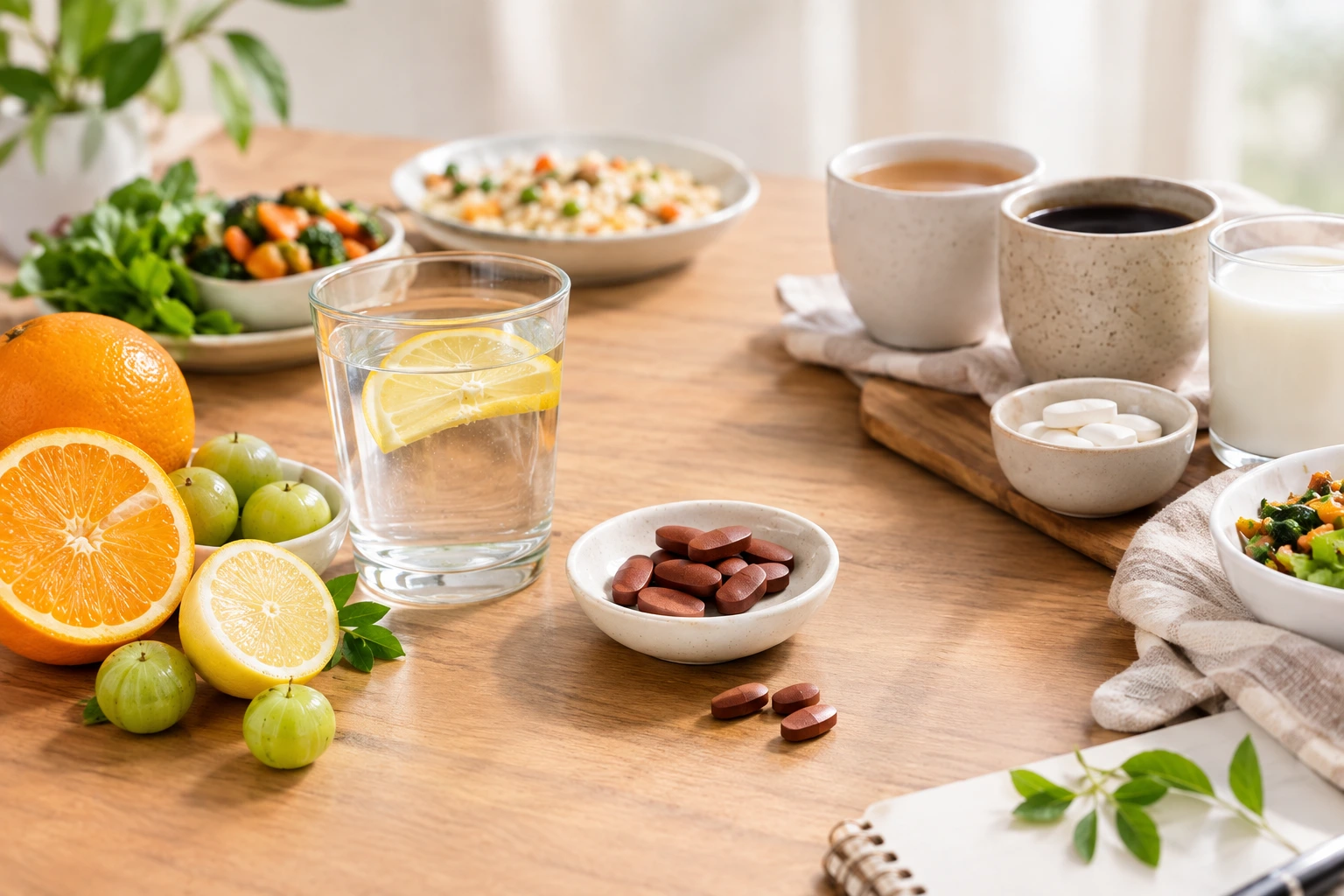
Give it four weeks. We repeat the hemoglobin test and see whether the number is climbing. Iron is also just one part of the picture — folic acid, B12 and calcium matter too, which we explain in our blog on supplements for a normal pregnancy.
Option 2: Diet — Support, Not a Cure
This is where many families get confused. Food is important, but once hemoglobin has already fallen, diet alone cannot pull it back up in time. Think of diet as the thing that holds your level steady while medicine does the actual lifting.
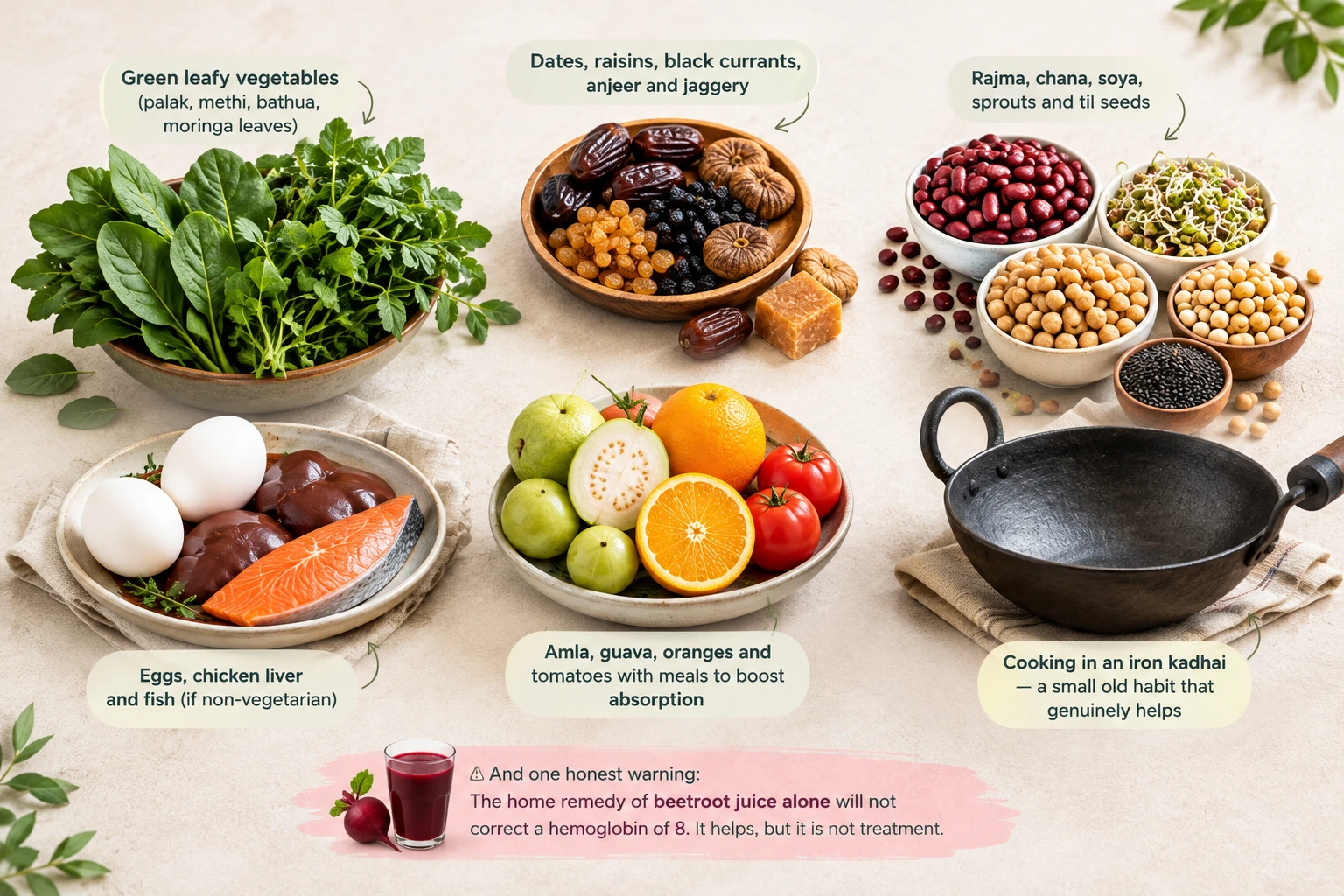
Foods worth adding to your daily plate:
- Green leafy vegetables — palak, methi, bathua, moringa leaves
- Dates, raisins, black currants, anjeer and jaggery
- Rajma, chana, soya, sprouts and til seeds
- Eggs, chicken liver and fish if you are non-vegetarian
- Amla, guava, oranges and tomatoes with meals to boost absorption
- Cooking in an iron kadhai — a small old habit that genuinely helps
And one honest warning: the home remedy of beetroot juice alone will not correct a hemoglobin of 8. It helps, but it is not treatment.
Option 3: IV Iron — When Anemia in Pregnancy Treatment Needs to Move Faster
Intravenous iron is given directly into the vein through a drip. It sounds serious, but it is a routine, well-tolerated procedure and usually takes 20 to 30 minutes. We recommend it when:
- Hemoglobin is moderately or severely low and the delivery date is approaching
- Tablets have been taken properly for four to six weeks with no real improvement
- Vomiting, acidity or gut problems make oral iron impossible to continue
- There is a known absorption problem or a history of heavy blood loss
- The pregnancy is already past the second trimester and there is simply no time to wait
IV iron is generally avoided in the first trimester and is always given under supervision. Most mothers tell us they feel noticeably more energetic within one to two weeks. In severe cases close to delivery, a blood transfusion may be advised instead — but with timely care, that is rarely needed.
So Which One Do You Actually Need?
Here is roughly how the decision is made:
- Mild anemia, early pregnancy → iron tablets plus a corrected diet
- Moderate anemia, tablets not tolerated → IV iron
- Moderate to severe anemia after 28–30 weeks → IV iron, because time matters
- Severe anemia with symptoms near delivery → IV iron or transfusion, decided case by case
The real work in anemia in pregnancy treatment is finding the cause, not just raising the number. Two women with the same hemoglobin can need completely different plans.
Where Dr. Madhumita Patel Provides Anemia Treatment in Delhi NCR?
Dr. Madhumita Patel is an obstetrician-gynecologist with more than 15 years of experience and is known as one of the best gynecologists in Delhi NCR. She runs two clinics under Dr. Madhumita’s Women Healthcare:
- Vasant Kunj — 2441, D-2, Near Exit Gate 2, Vasant Kunj, New Delhi 110070
- Chattarpur — City Speciality Clinic, B-192, Chattarpur Enclave Phase 2, next to the Dental Care Clinic
She is attached as a senior consultant with Sitaram Bhartia Hospital, Fortis Hospital and Rainbow Hospital, where she conducts deliveries and surgical procedures, and also serves as a senior consultant with South Asian University, Chattarpur, caring for students from SAARC countries.
Women from Vasant Kunj, Chattarpur, Mehrauli, Saket, Munirka, Hauz Khas, Gurugram and across South Delhi visit her for complete pregnancy care — from the first scan to safe delivery. You can see the full list of her gynecology and obstetric services here, or read more about the doctor.
Conclusion: Do Not Wait for the Next Report
Anemia is the one complication of pregnancy that is almost fully preventable — and almost always ignored until it becomes serious. Tiredness gets blamed on the pregnancy. The tablet gets skipped because it caused acidity. Three months pass, and now the options are fewer.
The right anemia in pregnancy treatment is the one that matches your hemoglobin level, your trimester and your body — and that decision takes five minutes in a consultation.
Book your consultation with Dr. Madhumita Patel today.
- Call: +91 8287939446 / +91 8800363137
- Email: contact@drmadhumitapatel.in
- Book online: drmadhumitapatel.in/contact
- Find us on Google & get directions: Dr. Madhumita’s Women Healthcare on Google Maps
If you found this helpful, please leave a review on our Google profile — it helps other mothers find the right care at the right time.
FAQs on Anemia in Pregnancy Treatment
1. What hemoglobin level is considered anemia in pregnancy?
Below 11 g/dL is generally considered anemia in pregnancy. Between 10 and 10.9 is mild, 7 to 9.9 is moderate, and below 7 is severe and needs urgent attention.
2. How long do iron tablets take to raise hemoglobin?
When taken correctly, you should see a rise within four to six weeks. If there is no improvement by then, the dose, the type of iron or the diagnosis itself needs to be reviewed.
3. Is IV iron safe during pregnancy?
Yes. IV iron is considered safe from the second trimester onwards when given under medical supervision. Mild side effects like a metallic taste or a brief headache can occur, but serious reactions are rare.
4. Can I treat anemia only with diet?
If your hemoglobin is borderline, a good iron-rich diet along with vitamin C may be enough. Once you are already anemic, diet supports the treatment but cannot replace it.
5. Does anemia affect the baby?
Untreated anemia increases the risk of preterm birth, low birth weight and poor iron stores in the newborn. It also raises the risk of heavy bleeding for the mother at delivery. Treated early, the outcome is usually completely normal.
Looking for the best gynecologist in Delhi for anemia in pregnancy treatment? Contact Dr. Madhumita Patel today!!!
Call Now: +91 8287939446, +91 8800363137
Clinic Address: Dr. Madhumita's Women Healthcare, 2441, D-2, Near Exit Gate 2, Vasant Kunj